CRUMBLING DEMOCRACY ! Weakened Institutions or BJP's attack on the Constitution ? Silent Assault on India's Regional Parties, Now Getting LOUDER.
From The Editor's Desk
June 16, 2026
| Article by : Abhishek Mahananda
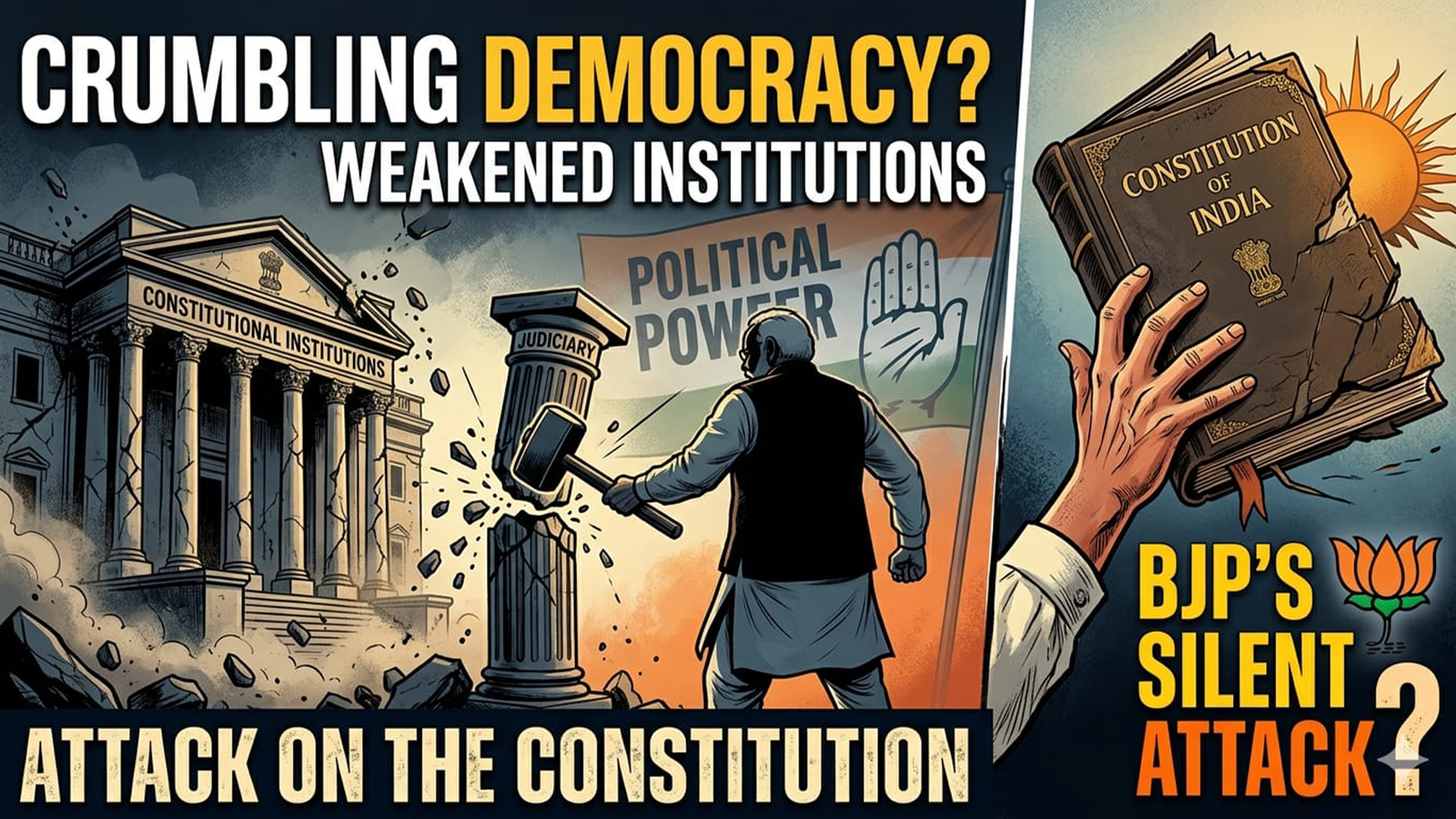
Indian democracy was built on diversity. Different languages, cultures, identities, and political aspirations found expression through strong regional parties. Today, that diversity faces its greatest challenge.
The BJP's political project appears to be moving beyond merely winning elections. Its larger objective seems to be the creation of a political landscape where regional parties are weakened, divided, absorbed, or rendered irrelevant. One by one, powerful regional forces are finding themselves under pressure.
The story has become familiar. A party grows strong in a state. Internal divisions emerge. Leaders defect. Governments fall. Factions are rewarded. The original party is weakened. What cannot be defeated electorally is destabilized politically.
The examples are impossible to ignore.
The split in the NCP fundamentally altered Maharashtra's political landscape. The division of Shiv Sena, a party founded by Bal Thackeray and long identified with the Thackeray family, demonstrated how even the strongest regional forces could be fractured.
The political tremors are now being felt across the opposition spectrum. In one of the most dramatic developments of recent times, a group of rebel Trinamool Congress MPs announced their merger with another political formation, creating a major crisis within the party and raising fresh questions about the future of regional political formations. Critics see this not as an isolated rebellion but as part of a larger pattern of fragmentation that ultimately benefits the BJP-led NDA.
The Aam Aadmi Party has faced a similar setback. The departure of prominent Rajya Sabha leader Raghav Chadha, along with several other AAP MPs, to the BJP dealt a severe blow to a party that once promised to emerge as a national alternative to both the BJP and Congress. Opposition supporters argue that the systematic weakening of regional and emerging political forces is creating an environment where only one dominant national force continues to expand while its rivals are pushed into crisis.
Viewed together, the splits in the NCP, the division of Shiv Sena, the exodus from AAP, and the rebellion inside the TMC paint a picture that deeply worries many opposition leaders. They fear that unless regional parties unite and present a common front, more parties could face similar challenges in the future.
This is not merely about governments changing. It is about altering the very character of Indian politics. Regional parties have historically acted as a check on excessive centralization of power. They ensured that Delhi listened to the states. Their weakening inevitably strengthens political centralization.
The concern among many opposition leaders is that the BJP seeks an overwhelming parliamentary majority that would allow it to reshape institutions and amend the Constitution with minimal resistance. Whether this objective is openly acknowledged or not, the fear is widespread across opposition ranks. For many critics of the BJP, the battle is no longer just about elections; it is about protecting the constitutional balance envisioned by the founders of the Republic.
The tragedy is that regional parties continue to fight one another while the ground beneath them is disappearing. Personal ambitions, local rivalries, and leadership egos have prevented the emergence of a united national challenge.
This is where the Congress party assumes importance. Despite its setbacks, it remains the only opposition party with a truly national presence capable of confronting the BJP across India. More importantly, Rahul Gandhi has emerged as the principal face of resistance against what many critics describe as the growing concentration of political power in the hands of a single party.
Whether through the Bharat Jodo Yatra, his advocacy on issues of unemployment, social justice, or democratic institutions, Rahul Gandhi has positioned himself as the only opposition leader with the reach and visibility to challenge the BJP's national narrative. It is no coincidence, many opposition supporters argue, that he remains the BJP's primary political target.
For regional parties, the choice is becoming increasingly stark. Continue fighting separate battles and risk gradual political extinction, or unite under a common platform to defend democratic pluralism. The Congress may no longer be as electorally dominant as it once was, but it remains the only political vehicle capable of bringing together a fragmented opposition.
The warning signs are already visible. Today it may be the NCP, Shiv Sena, Aam Aadmi Party, or Trinamool Congress. Tomorrow it could be the Samajwadi Party, the Biju Janata Dal, or any regional party that refuses to fall in line. No party, however powerful in its state, should assume it is immune.
History shows that democracies are strongest when power is distributed, challenged, and questioned. When opposition voices are fragmented and weakened, democracy itself becomes poorer.
The survival of India's regional parties is no longer just a political question. It is a question about the future balance of power in the world's largest democracy.
If regional parties genuinely wish to preserve their identity, influence, and relevance, they must recognize the scale of the challenge before them.
Who next - Samajwadi Party ? Biju Janata Dal ?
The time for opposition unity is not tomorrow.
It is NOW !