A Question of Balance: Has India’s Foreign Policy Lost Its Strategic Autonomy?
From The Editor's Desk
March 16, 2026
| Article by : Abhishek Mahananda , Editor in Chief
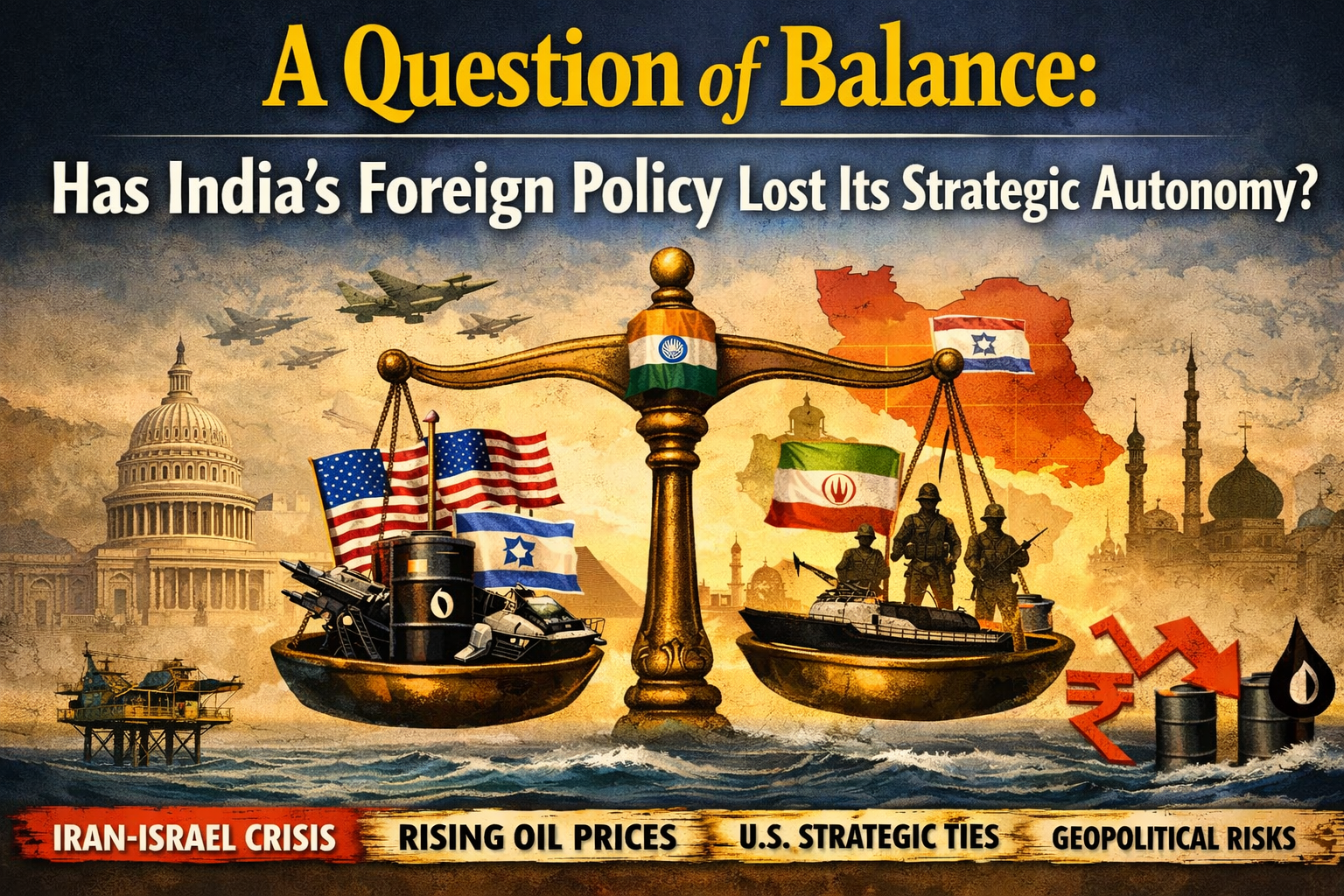
India has historically positioned itself as a moral voice in global diplomacy- one that values sovereignty, dialogue, and strategic independence. From the era of non-alignment to the diplomatic balancing acts of the post-Cold War world, New Delhi cultivated a reputation for engaging with competing powers while maintaining its own national interest. However, recent developments in West Asia, particularly the escalating confrontation between Iran and Israel, have reignited debate over whether India’s foreign policy under Prime Minister Narendra Modi is drifting away from that tradition of balanced engagement.
*The Iran–Israel Crisis and India’s Position*
The recent military confrontation between Iran and Israel has created a volatile environment across the Middle East. For India, the stakes are high. The region supplies a significant portion of India’s energy imports, hosts millions of Indian workers, and remains crucial for maritime trade routes connecting Asia, Europe, and Africa.
In the unfolding crisis, India’s diplomatic response has been perceived by some analysts as unusually cautious toward Israel and closely aligned with Western positions, particularly those of the United States. Critics argue that such positioning marks a departure from India’s historically calibrated diplomacy, which sought to maintain constructive relations with all sides—including Iran, Israel, and Arab states.
India has traditionally balanced these relationships with care: Israel as a defense partner, Iran as an energy supplier and gateway to Central Asia, and the Arab world as both a strategic and economic partner. Any perception that New Delhi is tilting decisively toward one axis risks undermining this delicate equilibrium.
*Economic Repercussions Already Visible*
The economic consequences of tensions in West Asia are immediate and potentially severe for India. Oil prices tend to spike during geopolitical instability in the region, placing pressure on India’s import bill and widening fiscal vulnerabilities.
India imports more than 80 percent of its crude oil requirements, and disruptions in the Persian Gulf region directly translate into higher energy costs, inflationary pressures, and stress on the rupee. If the conflict intensifies or disrupts shipping routes such as the Strait of Hormuz, the ripple effects could be significant.
Higher energy costs would likely affect transportation, manufacturing, and consumer prices across the Indian economy. Additionally, uncertainty in the region could impact remittances from Indian workers in Gulf countries—an important source of foreign exchange for India.
*Strategic Dependence on the United States*
Another dimension of the debate concerns India’s growing strategic proximity to the United States. Over the past decade, bilateral ties have deepened significantly in defense cooperation, technology partnerships, and geopolitical alignment in the Indo-Pacific.
While stronger relations with Washington offer advantages, critics warn that excessive reliance on any single global power can dilute India’s long-standing principle of strategic autonomy. Historically, India’s foreign policy was guided by a belief that national interests are best served through diversified partnerships rather than alignment with a single geopolitical bloc.
Skeptics of the current approach argue that the United States’ own foreign policy record,particularly in the Middle East—has often been marked by shifting alliances and interventions that have produced long-term instability. From this perspective, blindly trusting any major power’s strategic direction could expose India to unintended diplomatic and economic risks.
*The Question of International Law and Sovereignty*
India has traditionally championed international law and respect for national sovereignty, principles rooted in its own history of anti-colonial struggle. Critics of the government’s recent positioning argue that India must consistently apply these principles, regardless of geopolitical pressures or strategic partnerships.
Any perceived silence or ambiguity in situations involving cross-border military actions or violations of territorial sovereignty can weaken India’s moral standing on the global stage. For a country that has long advocated peaceful dispute resolution and multilateral diplomacy, maintaining consistency in these values remains critical.
*Future Risks for India*
The coming weeks may test India’s diplomatic agility. A prolonged conflict between Iran and Israel could reshape the geopolitical landscape of West Asia, forcing countries like India to navigate increasingly complex alliances.
*Possible consequences include:*
- Sustained volatility in global oil markets
- Increased risks to maritime trade routes
- Strategic pressure from competing global powers
- Diplomatic friction with traditional partners in the Middle East
India’s challenge will be to preserve its national interests without appearing subordinate to any geopolitical bloc.
*A Need for Strategic Recalibration*
Foreign policy is rarely static. It evolves in response to shifting global realities. Yet, the essence of India’s diplomatic strength has historically been its ability to maintain independence of judgment while building relationships across ideological divides.
As the Iran–Israel crisis unfolds, the debate within India’s strategic community is likely to intensify. The key question remains whether New Delhi can reaffirm its legacy of balanced diplomacy—one that protects economic stability, respects international norms, and safeguards India’s long-standing reputation as an independent voice in global affairs.
In a world increasingly defined by geopolitical polarization, strategic autonomy may prove to be India’s most valuable diplomatic asset.